Painting, No-Painting
Updated: 6 days ago

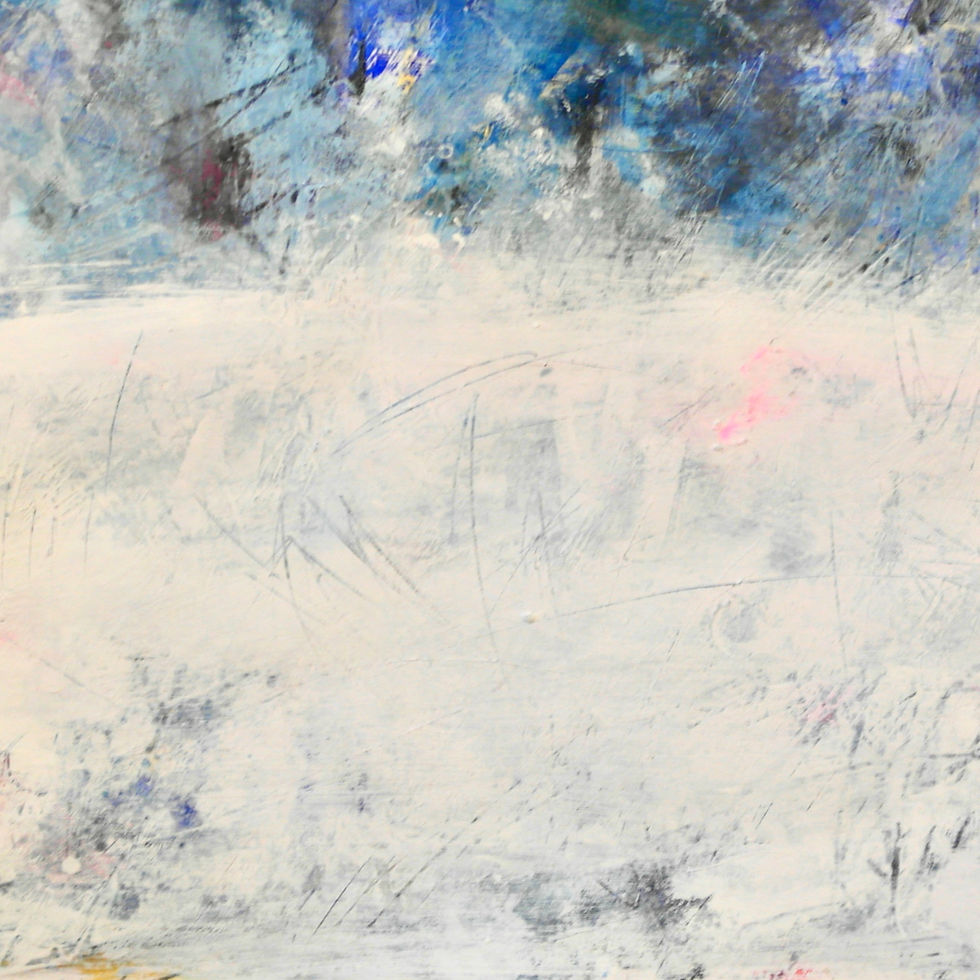
There is a strange resemblance between non-dual meditation and painting abstracts. When we stand before a piece of paper, a board or a blank canvas it is like we are confronted by the Ground out of which may come experiences of nirvanic liberation or the opposite, samsaric entanglement. It is an openness that in that first moment of recognition holds all possibilities. What follows is entirely up to us. This is a good moment to pause and pause for a long time. What do I find arising within my my mind? Is there an urge to simply turn away, the spaciousness being felt as threatening or overwhelming. Is there a movement to quickly put something down into that space, to get something, anything done so that it is covered over. Or do we come with a pre-formed idea, hardly seeing the space as it is instantly obscured by our intention. None of these reactions are wrong or bad. But gaining insight into their presence is the first gift of that white expanse.
And then comes the first mark. I sometimes make this with a big loaded brush and look away as it goes down. What I hope to invite is something full of life, something full of spontaneity. Something like the Japanese Zen circles – ensō – that express in a single stroke the painters buddha-nature in that moment of making. Impossible to correct or improve, it is either there or not. This too is all about intentionality. How do we rest in non-dual awareness? We simply look and then do nothing. Of course what actually happens is we look and then look again to check we have looked properly the first time. Dropping a handkerchief so that it naturally falls to the ground, we grasp it as it falls so to assist its descent.
And so with painting. I know I must relax and trust that the moment to make the next mark will come. And I also know that everything in me will be straining to make that mark before the arrival of this moment. It is almost impossible not to jump in and take over. To prevent my intentionality from attempting to create a facsimile of doing nothing. Furthermore, as the painting unfolds, the temptation gets stronger. Rather than resting in the space of the painting and letting it lead, I start to take control. I start to want it to resemble paintings that I feel have worked before. Or look like the paintings of others that I believe work. Even the notion of ‘work’ is an imposition because my thoughts about working and not working are in themselves the very things that get in the way. Here is a world that invites surrender. I could almost say not caring but that is not correct as this could easily conceal a defence - “I don’t care what happens, none of this really touches me”. But this would be a lie. It is desperately important and something that can only be held lightly both at the same time. An impossible paradox that must be left to itself to resolve.
Then, when it all feels a big muddy mess, when the life of the painting has degenerated into a meaningless pattern, there come a pressing need to break out. Life asserts itself, a gesture is made that instantly destroys all the painful work beneath it. A slash of vivivid no-thought intervention that takes the trite and tricksy and in an instant shakes it back into authenticity. I love this moment. Often achieved with a fearless mass of white or black, it blasts the whole thing off again. What do the yogis say? After a while break our meditation and then establish it again. Look and break and then look again. Keep it fresh, do not let instant presence slip into a state that resembles the real thing but is not. No moment of awareness - or painting - is the same as anything that has ever gone before during the entire history of the universe. Attempting to create more of the same is to cheat.
Within the Tibetan tradition of the Great Perfect the teaching anticipates all this. How

are we to practice? We practice through the Four Ways of Leaving Things as They Are. We leave our body as we find it - no need to spring into a taut meditation posture. We leave our eyes relaxed and open - no need to peer about or fix steadily on a single point. We leave whatever appears just as it is - because all appearances irrespective of what they are, are by nature equally awareness. And we leave awareness as what it already is - just simple, ordinary awareness. This is to practice ‘non-modification’. There is nothing to change or improve.
Oh yes, one last thing. When is a painting ‘finished’? This is my latest challenge. Sometimes I really like what has emerged from my painting practice, and encouraged by those who guide me, I paste it into my sketch book usually edited down and sometimes added to with collage. This is one vast danger zone. With every entry there builds an idea of something getting better and with that the desire to replicate it. How wiser it would be to truly embrace the reality that just about everything I do is just something in progress and be free of the demon of expectation. Nothing is ever ‘finished’. How can it be in a universe that is in perpetual change? Painting abstracts reveals the empty nature of all appearances. They don’t even stop at some point, they are always life unfolding.
NW. 13 September 2026


One of your best pieces yet. Especially love the colourful painting. Also enjoyed the catching the hanky analogy. Nigel seems to be bursting out . Fantastic. Jx
Oh boy, this is familair! Not that I'm a painter, but the urge to take control, make a structure, make a decision ... It's hard to let go of control and trust, in so many aspects of life. Ego/controller always interfering, wanting to take charge. Driven by fear, I guess, as so often!